
We design e-learning that helps people make better decisions at work.
From the first ideas and course structure to a finished product ready to launch in your LMS. If you need a partner who can take ownership of the process, we'd be happy to talk.
Before we choose a format, let's understand the problem.
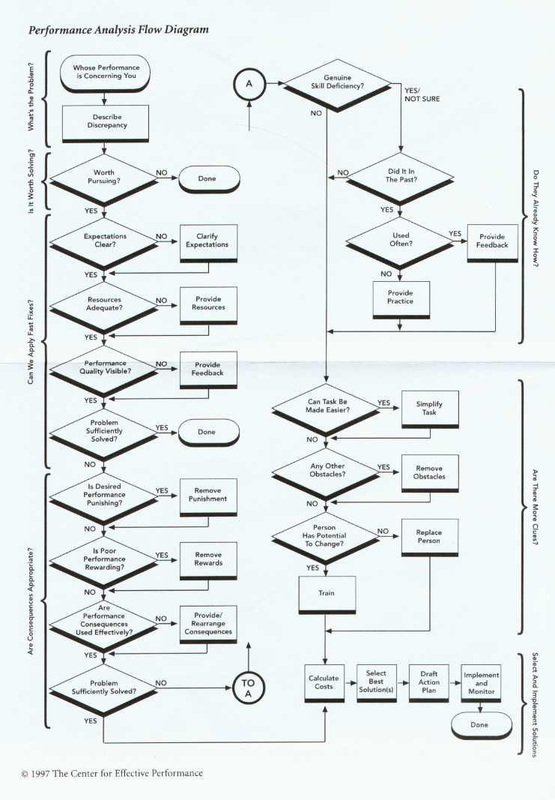
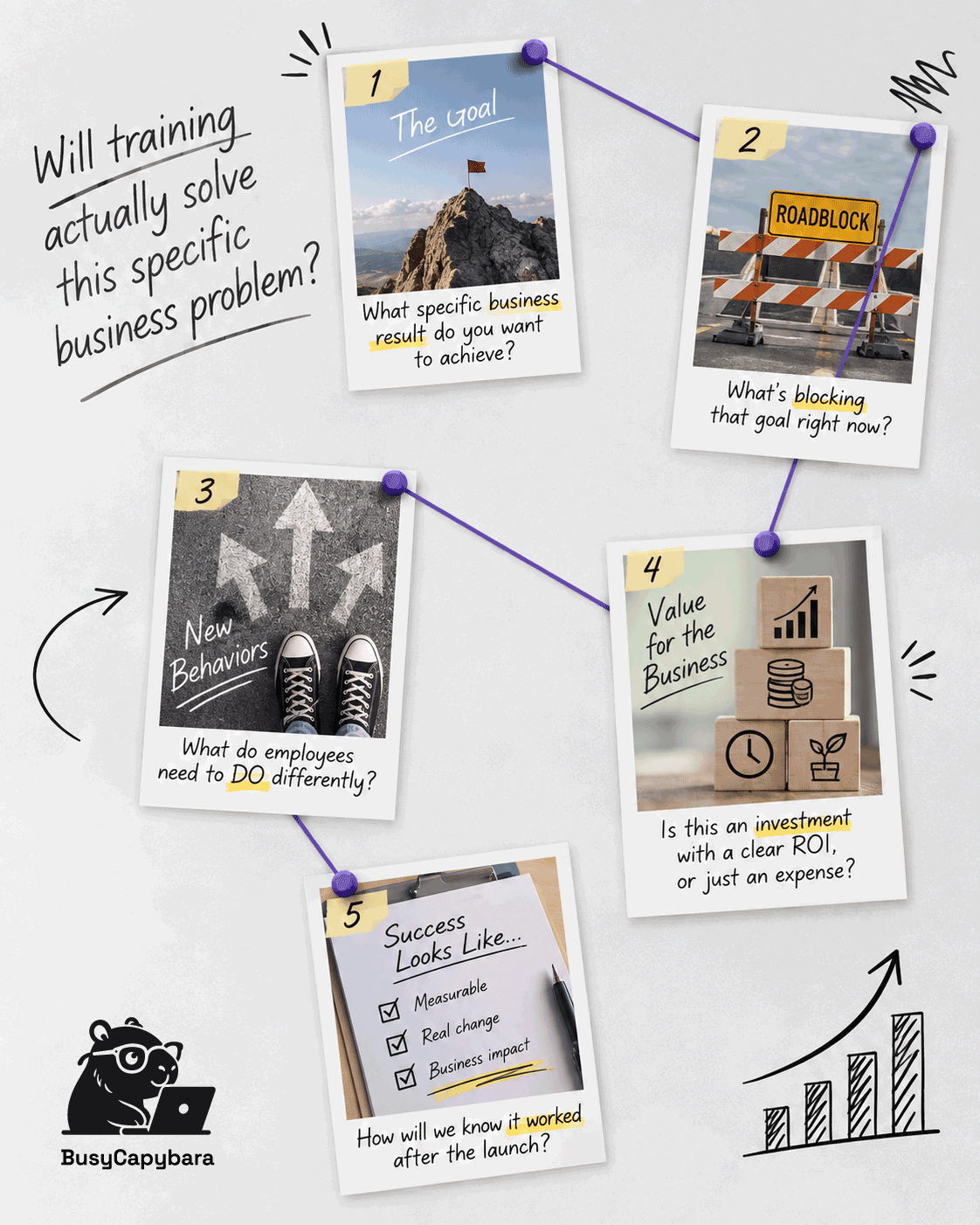
When a team has a performance problem, the conversation often jumps straight to solutions: should we build a course? Run a workshop? Train the team? We wanted to start one step earlier.
Performance Navigator is a free, 10-minute diagnostic tool that helps you explore what might be behind your team's performance problem — before deciding what to build or change.
Sometimes it's a knowledge or skill gap. Sometimes the cause lies in expectations, processes, tools, KPIs, or feedback. The goal is to help you see the possibilities more clearly.
Try it now{{ p }}
{{ p }}
How can we help?
Every project starts differently — sometimes there's just an idea, sometimes a 200-slide presentation, sometimes a course that's overdue for an update. So we don't offer one-size-fits-all solutions.
Have a project in mind? Let's talk.
Even if it's still just an idea, we'll help you work out where to start and provide a clear cost estimate.
Learning products built around your problem, not a template.
Instructional design, custom development, translation and localisation — chosen to fit the problem you're actually solving, not a fixed package.
Start with the cause
Not sure which of these you need? Our free Performance Navigator screening weighs seven possible causes behind a performance problem in 7–10 minutes, so you can pick the service that targets yours.
Core services
Additional capabilities
A general sense of typical budgets.
Every project includes project management, development and testing, agreed review cycles, and delivery of the source files. These figures are a general guide, not a formal quote — you'll receive a fixed price and timeline once we understand your project.
Not sure which service is right for your project?
Tell us what you're trying to achieve — we'll suggest an approach even if it doesn't fit neatly into a category above.
A clear process, from first conversation to launch.
We follow a straightforward learning development process, so you always know what happens next, what we need from you, and what you can expect from us.
Whether you come with a detailed brief or just a business problem, we can work from there. We can adapt to your existing processes, stakeholders, review cycles, brand requirements, and technical environment, while taking care of the day-to-day project management ourselves.
{{ p }}
You can start this process yourself with our free Performance Navigator. It takes 7–10 minutes and helps you explore seven possible factors behind a performance problem.
A process you don't have to manage
You don't need to coordinate every task between instructional designers, developers, designers, and technical people. We manage the project from our side and remain your main point of contact throughout.
You know what's happening, when your input is needed, and what we're working toward. We take care of the rest.
Our working principles
Your approach different? Let's discuss it.
However you like to work, we'll find a process that fits — tell us about your project and how you'd like to run it.
See how we work through real projects.
Problems we've solved for real clients — from the business question to the finished solution.
Business problems first, training when it's the answer.
Solving a business problem and delivering training are not the same thing — sometimes training isn't even the right answer. Here you can see how we actually work through a project, from the problem to the solution.
A culture of recognition and feedback
Managers praise on instinct, often ineffectively — the company keeps losing people without tracing the cause back to something fixable.
Read the case studyRecognizing phishing in the moment
Employees decide, in about 21 seconds, whether to click a link, and a once-a-year briefing doesn't prepare them for that moment.
Read the case studyThe Study Day: clinical judgment at the visit
Investigators know the protocol. What goes wrong is the live conversation with a participant, under time pressure, where one missed question changes the outcome.
Read the case studyHave a challenge like these?
Tell us about your project and we'll suggest an approach — reusing an existing idea, or designing a new one.
Experiments that answer real questions.
These aren't just design experiments. Each one starts from a real question we ran into while building a course, and a working solution we found for it — ready to reuse in a real project.
Have a challenge like these?
Tell us about your project and we'll suggest an approach — reusing an existing idea, or designing a new one.
{{ activeIdea.title }}
{{ activeIdea.subtitle }}
{{ activeIdea.interactiveNote }}
{{ activeIdea.problem }}
{{ activeIdea.idea }}
{{ activeIdea.solves }}
{{ activeIdea.sideCta }}
{{ activeIdea.interactiveNote }}
Source
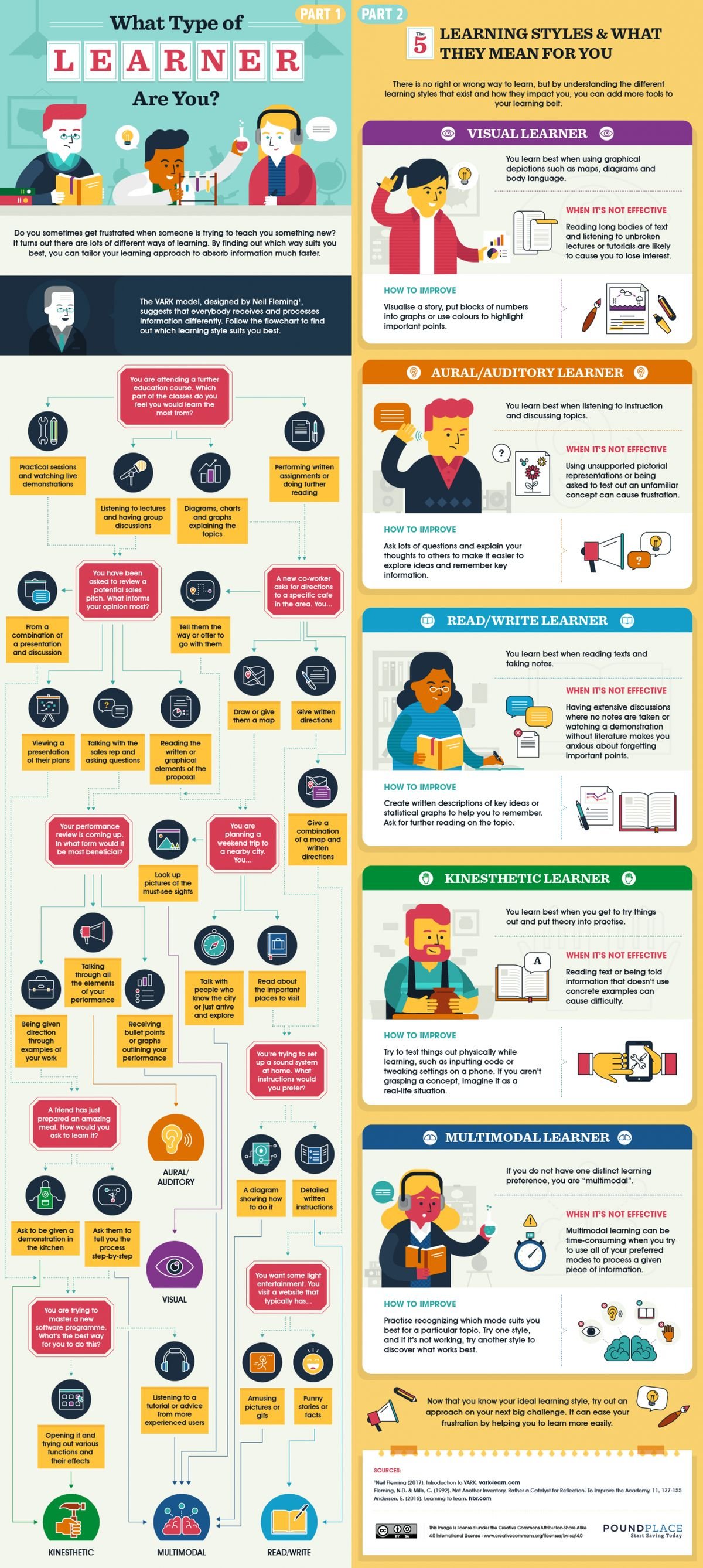
VARK is a model proposed in the 1980s suggesting people learn best through one of four modes: visual, aural, read/write, or kinesthetic. It became widely popular in education, though later research found no evidence that matching teaching style to a "preferred" mode improves learning outcomes.
{{ activeIdea.sourceNote }}
{{ activeIdea.problem }}
{{ activeIdea.idea }}
{{ activeIdea.solves }}
{{ activeIdea.honestNote }}
{{ activeIdea.cta }}
{{ activeIdea.cta }}
{{ activeIdea.moreExamplesNote }}
{{ ex.interactiveNote }}
{{ ex.note }}
{{ ex.ctaText }}
{{ ex.interactiveNote }}
{{ ex.note }}
{{ ex.ctaText }}
A culture of recognition and feedback
Most managers praise on instinct, often ineffectively, and the company keeps losing people without ever tracing the cause back to something fixable.
Recognition isn't a soft skill you check off a list. It's a measurable lever for retention and profit, and the numbers above make the case on their own.
Sources: gallup.com, heytaco.com, gitnux.org
A bank of situations
A bank of dialogue-based simulations that managers complete in short sessions, spaced a week apart, not a one-off training.
A single introductory module sets the context and the theory. A series of standalone simulations then puts the manager through real situations built around their own teams.
Each time, the manager practices a concrete skill: what to say to an employee in the moment, instead of sitting through an abstract lecture on why recognition matters.
Try it yourself: one dialogue simulation
What one of these dialogue simulations could look like. Pick your words and see how the employee responds.
{{ w.text }}
The core is a bank of dialogue simulations. Each one is self-contained: a short situation, several response options, an employee reaction that depends on the choice, and a debrief explaining why the chosen line worked or didn't. One introductory module covers the problem, the numbers, and the minimum necessary theory.
Delivery adapts to the client's infrastructure rather than being hard-wired into the architecture:
{{ m.text }}
A manager needs to recognize a team member, Jordan, after a tough project. Three response options, three different outcomes.
Recognition and Feedback, Storyboard.docx ↓Have a challenge like this?
Tell us about your project and we'll suggest an approach — reusing an existing idea, or designing a new one.
Recognizing phishing in the moment
Cybersecurity isn't just firewalls and antivirus software. First and foremost, it's a person deciding, in about 21 seconds, whether to click a link. Most employees go through a security briefing once, when they're hired, and never train that skill again, while attacks keep getting faster and more convincing.
A one-time briefing produces a spike in vigilance that fades within weeks. The gap between knowing what phishing is and recognizing it the moment it lands in an inbox is exactly what a single course can't close.
Sources: swif.ai, abnormal.ai, totalassure.com
A training module, plus unpredictable drills
A short, standalone training module covering the fundamentals, plus training drills: simulated phishing attacks that land in an employee's real inbox at random moments, with no set schedule.
The module is completed once, with periodic updates as new attack types emerge, and establishes the principles of recognition. The drills are not a course in the usual sense, but a continuous, unpredictably-timed stream of simulated attacks.
Inside that same module, right after the theory, sits a practice exercise: a series of real or constructed emails the employee marks as safe or suspicious, in a calm setting with no time limit and no pass-or-fail score. It's the bridge between reading about phishing and actually catching it.
Once that groundwork is in place, the training drills take over as a second, ongoing layer: not a course in the usual sense, but a continuous, unpredictably-timed stream of simulated attacks.
The employee doesn't know whether a given email is a drill or a real one, so they react the way they would to an actual threat. The learning happens at the moment of reaction, not on a schedule, and that's the core of the approach.
Try it yourself: safe or suspicious?
The practice exercise from the module. Go through a few emails and mark each one.
{{ w.text }}
The training module, built once, outside the schedule of drills, covers the problem, the numbers, and the basic principles of recognizing an attack. It doesn't train the skill by itself. It lays down the vocabulary and framework that the later debriefs build on.
Inside that same module, a practice exercise lets the employee mark a series of real or constructed emails as safe or suspicious. No time limit and no pass-or-fail benchmark, this is a calm exercise in attention to detail, before the real, unpredictable drills begin.
The training drills run on a separate mechanic, on top of the company's real inbox:
{{ m.text }}
The interactive sample above mirrors the practice exercise inside the training module: a mix of real phishing attempts, borderline-but-legitimate emails, and normal messages, each with a quick check asking whether you'd reply.
Cybersecurity, The Human Factor, Storyboard.pdf ↓Have a challenge like this?
Tell us about your project and we'll suggest an approach, reusing an existing idea, or designing a new one.
The Study Day
An interactive clinical judgment trainer for clinical trial investigators.
Behind each of these numbers is not a gap in protocol knowledge but a gap in behavior at a specific visit. An investigator usually knows what a protocol deviation is and why informed consent matters, because that is taught when a study starts. Regulators record Protocol Compliance as the top finding category for investigators not because someone failed to read the protocol, but because in a live visit, under time pressure, with an anxious participant or an unobvious symptom, the right action takes a rehearsed habit of noticing a signal and acting on it, not an assumption that "it's obvious anyway." Poor communication with the site is also a steady, separate reason participants leave. The same conversation with a participant that determines data quality also determines whether that participant stays in the study at all.
Why train on the conversation and not on the procedure. FDA and EMA findings show that documentation (the Trial Master File) is not the main problem for investigators. It ranks first for sponsors and CROs. For investigators, Protocol Compliance ranks first, which means what happens in the exam room with the participant: which questions were asked, what was noticed, what was documented or escalated in time. That is exactly the behavior The Study Day trains, rather than a general checklist of regulatory requirements.
Sources: goodwinlaw.com, pmc.ncbi.nlm.nih.gov, bekhealth.com, contractpharma.com, pro-ficiency.com, proofpilot.com, advarra.com, medixteam.com
One working morning as a Study Physician
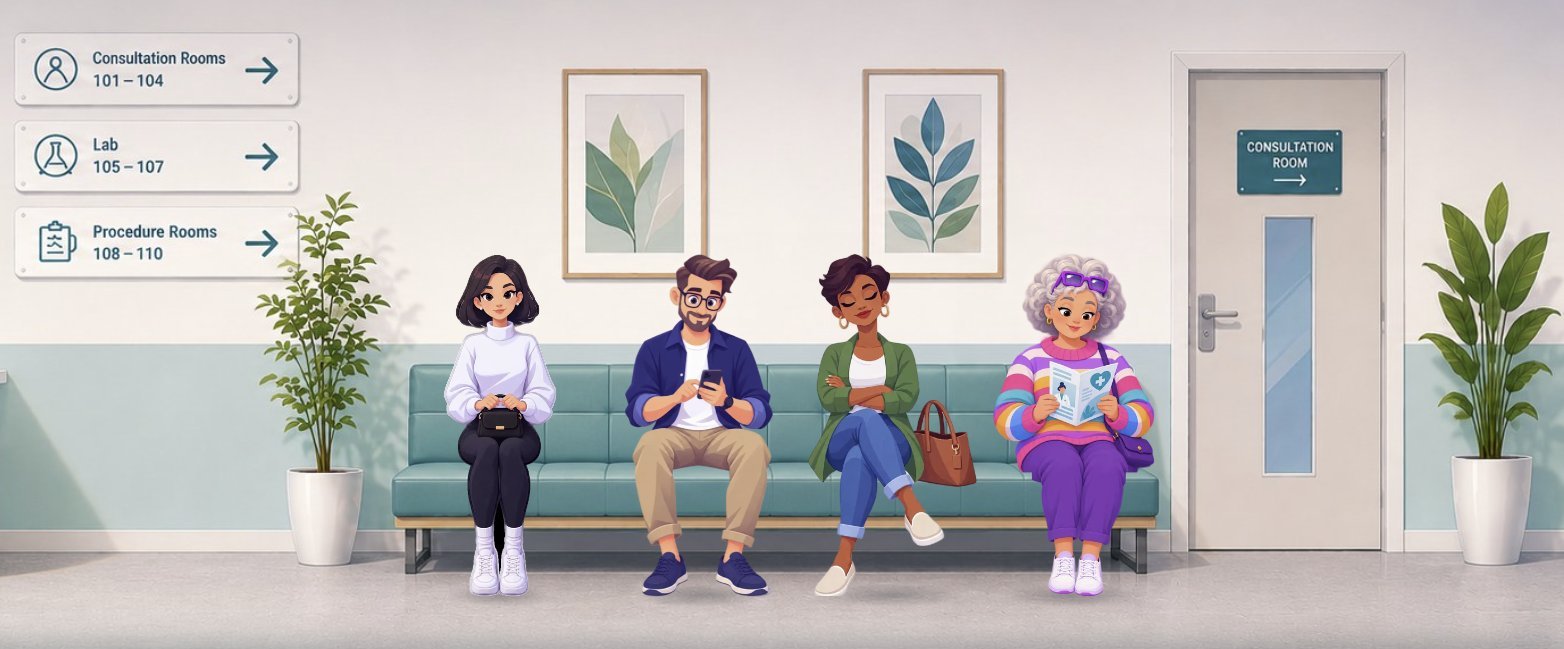
The Study Day is an interactive branching trainer in which the learner lives through one working morning as a Study Physician. Four study participants are in the waiting room, each with their own situation and chart. The order in which to call them in is not suggested. Each visit is a conversation with real forks: what the participant says depends on exactly what the physician asks, and nothing is revealed automatically.
At the end of the day there is no pass/fail score, but a personal debrief of the learner's behavior pattern: where decisions were precise, where they were not, and which specific question or conclusion would have changed the outcome.
Play the demo: a morning at the study site
A playable version of The Study Day. Choose who to call in first and lead the visit yourself.
Opens full screen in the mobile version. Works in portrait and landscape.
Every decision changes what happens next
The core of the product is a branching scenario, not a set of identical slides with questions. The physician enters a waiting room with four participants, each with a short status and a chart available on request (sex, age, relevant history details). The physician decides whom to call first by reading these charts, not by a suggested order.
Each visit is a conversation with 3–4 key forks, not a long chain of identical steps. The participant says one line, the physician chooses one of several plausible replies. There is no obviously "wrong" option, but each leads to a different continuation of the conversation and reveals (or does not reveal) an important detail.
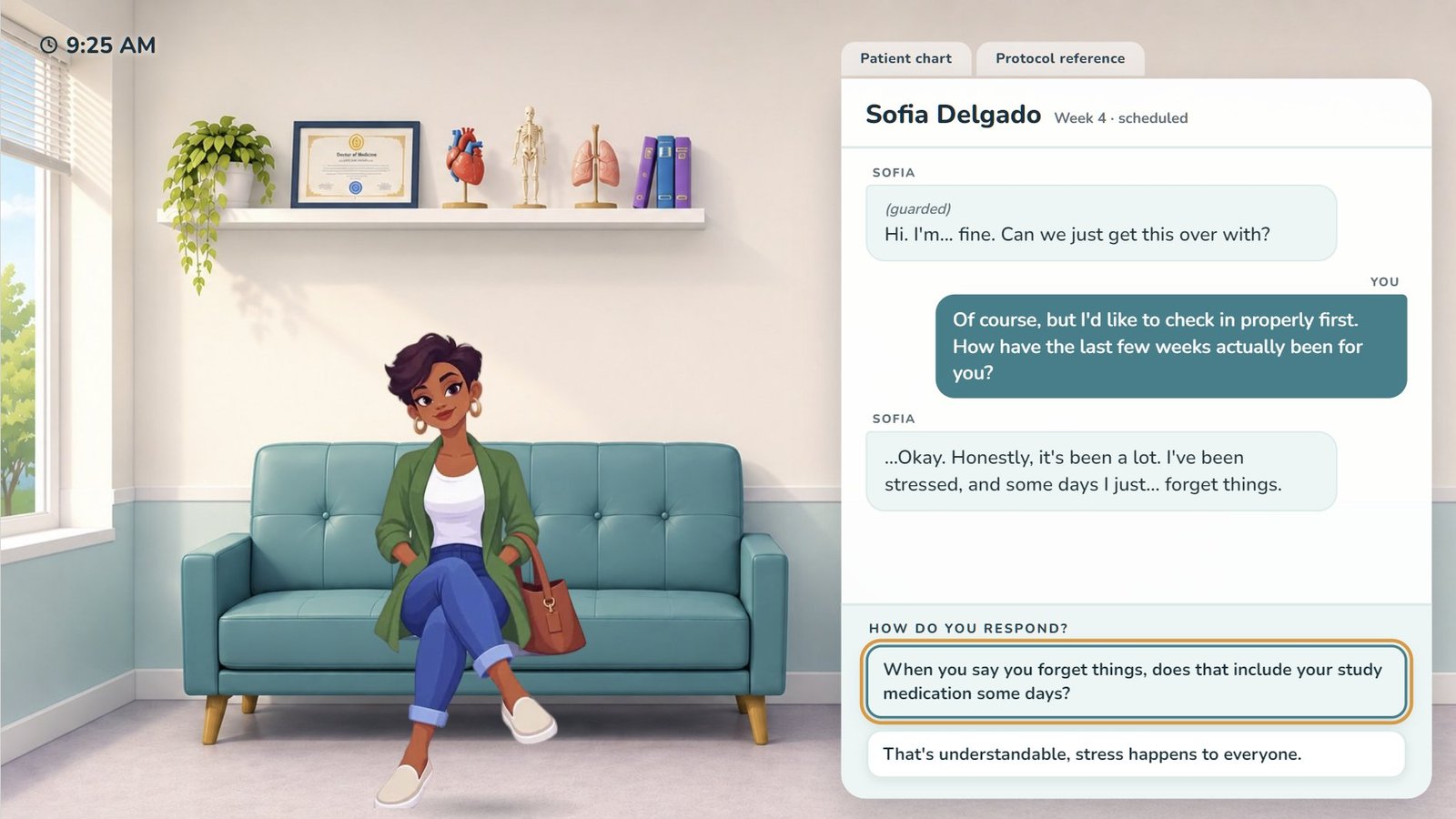
The system remembers decisions but shows no score during the day. In the background it records which of four behavior types each choice belongs to: how closely the physician listened, how well they noticed important details, how humanely they communicated, how accurately they judged the seriousness of the situation. The physician sees this only at the very end.
During a visit, a small reference aid is available: general information about the study that helps with orientation but does not say directly what to do with a specific participant. Just as in reality, you can check a reference, but the decision is still made by the person.
After four visits the trainer picks the 2–3 most noticeable patterns in the physician's behavior and explains them in plain language with a concrete example, as if someone had really watched your morning instead of just awarding points.
Accessibility. The demo is fully operable by keyboard, announces the dialogue to screen readers, keeps focus inside dialogs and returns it when they close, honors the reduced-motion setting, and offers a "Skip intro" control for the opening animation.
About the illustrations. The visual style is a reference taken from the Magnific service: only the style and the general feel of the picture are used, with no borrowing of specific images. All illustrations the learner sees were generated separately for the course context, for the specific participants and scenes of the scenario.
{{ w.text }}
The full design specification: the waiting room, all four visits, every branch, and the logic behind the end-of-day debrief.
The Study Day, Storyboard.pdf ↓Have a challenge like this?
Tell us about your project and we'll suggest an approach, reusing an existing idea, or designing a new one.
Meet BusyCapybara
We're a small eLearning agency that likes solving complicated learning problems without making complicated learning.
We design and develop custom digital learning for organizations that need more than information moved from a document onto a screen.
Sometimes that means a full eLearning course. Sometimes a scenario, simulation, interactive tool, or a small learning experience built around one very specific problem. And sometimes the useful answer is that another course isn't what you need at all.
That's why we start with questions.
What should people be able to do differently? What is getting in their way now? What does training actually need to change?
Once we know that, we build only what needs to be built.
Small team. Serious eLearning. No unnecessary complexity.
What we want & how we do it
Good eLearning isn't defined by the number of interactions, screens, animations, or features it contains.
It works when people can understand what matters, practice what they need, and use it when the course is over.
That idea shapes both where we want BusyCapybara to go and how we work today.
To make workplace learning more useful, thoughtful, and worth people's time.
We want organizations to expect more from eLearning than content delivery — and learners to expect more than clicking Next.
We turn real performance needs into focused digital learning experiences.
We combine instructional design, visual design, technology, and practical development to create solutions around what people actually need to do — not around how much content there is to cover.
We question assumptions before building, simplify where complexity adds nothing, and use technology when it creates a better learning experience rather than simply a more impressive one.
Why we should be partners
Because you probably don't need another vendor who simply builds what is written in the brief.
You need someone who can work with you on the problem behind it.
We don't want to build you more eLearning.
We want to build the right amount of eLearning for the problem you actually have.
Tell us what's going onNotes on building learning that works.
Thoughts on instructional design, visual communication, and building corporate training that actually works.
{{ activePost.title }}
{{ activePost.excerpt }}










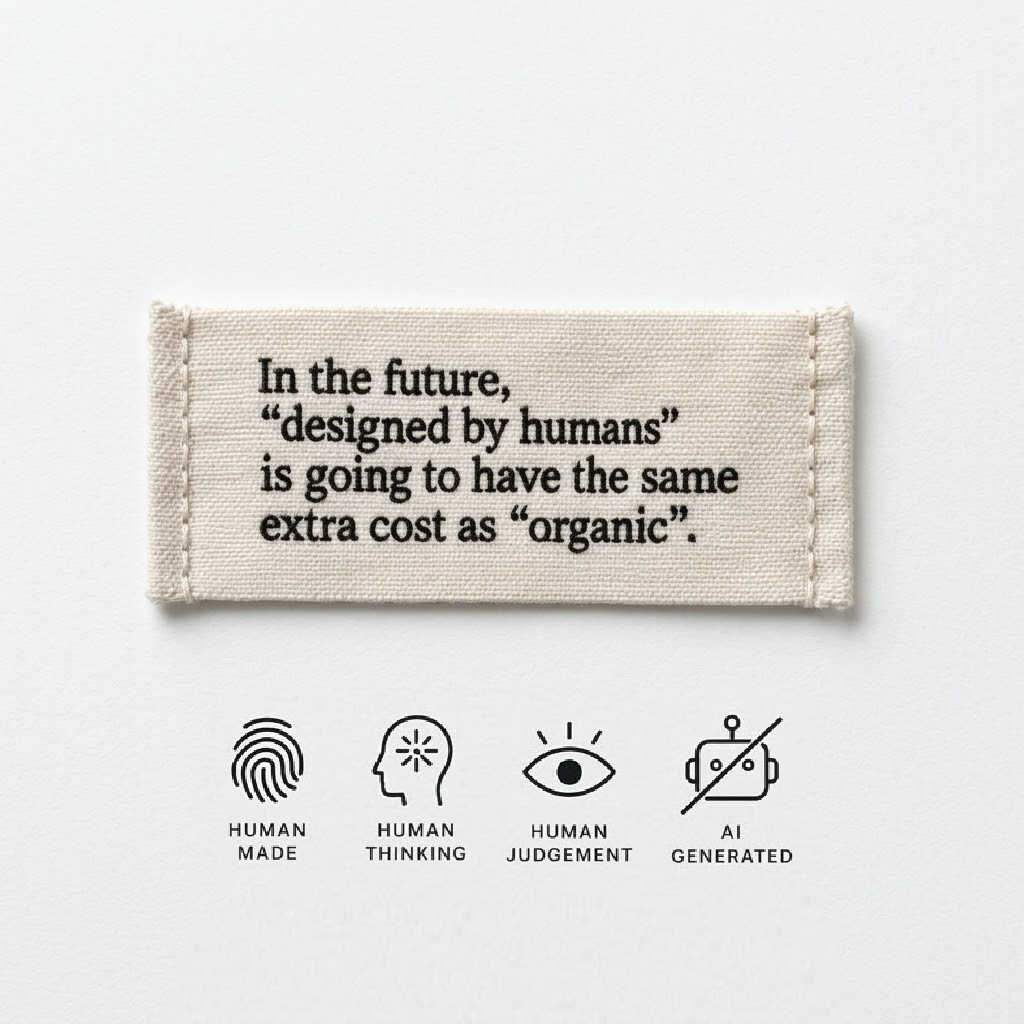
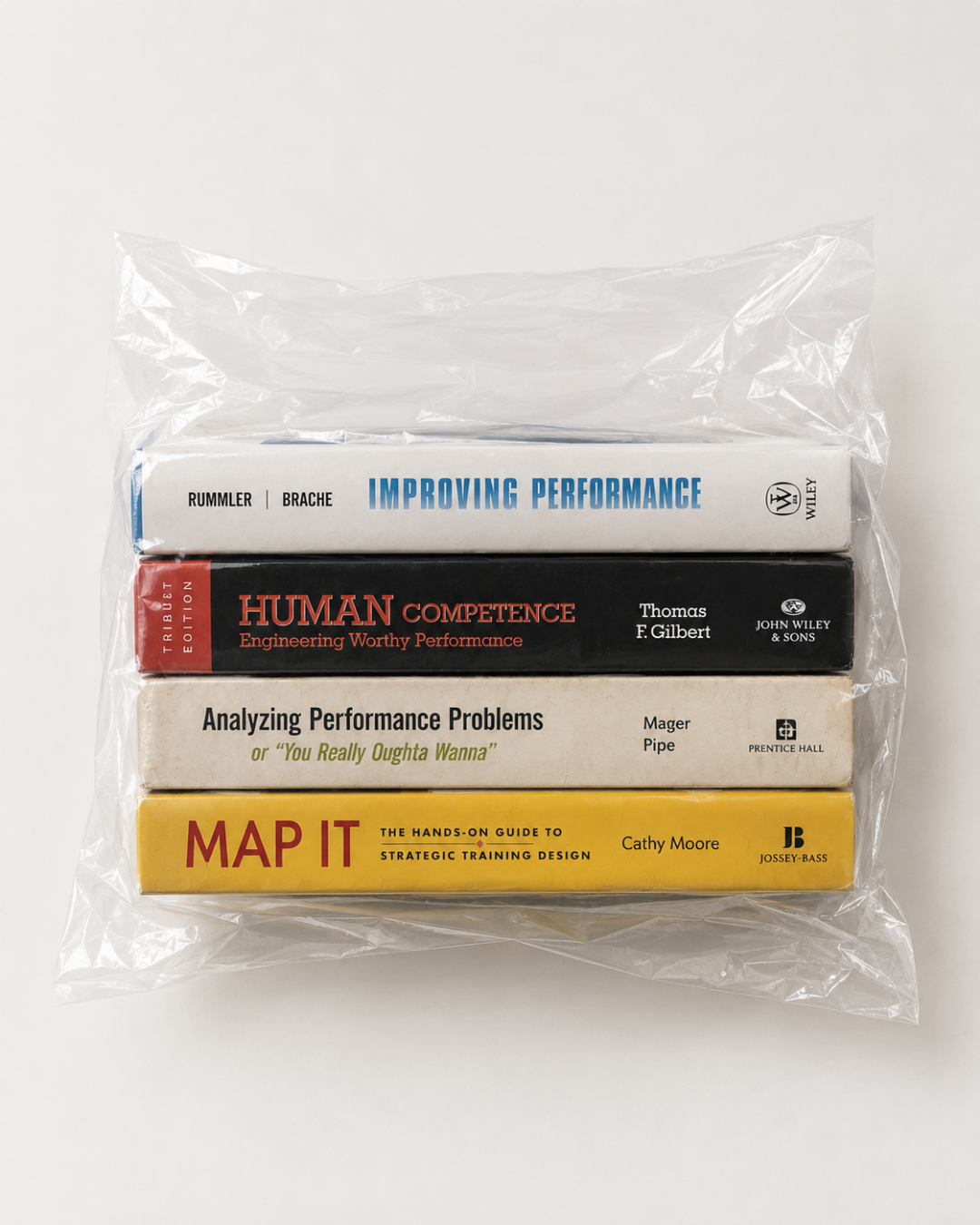
Scale runs to $0.15 per word.
Human rates from an Alconost analysis of 3,200+ localization projects. Articulate's figure is its own published estimate for credit-based translation.
Illustrative model, not a market average.
Pre-delivery: 10 hrs review at $45/hr. Post-delivery: 15 hrs linguistic QA, 8 hrs rebuild, 4 hrs project management, plus a $400 client credit.
Nobody checks the output before it ships
One extra review cycle — and someone who answers for the result
The AI-only chain is faster by one review cycle. The second chain is where accountability for the delivered course actually lives.
Roughly 2–3 weeks, several calendars to sync
About 5 minutes, no meeting to schedule
Same diagnostic question — minus the part where you answer to an expert.
Packaging design, 3,600 consumers — not learning content. Read it as a pattern, not a number to reuse.
The signal buyers respond to isn't “no AI” — it's visible human effort in the process.
{{ block.text }}
{{ block.text }}
Not sure which part applies — knowledge, environment, or process?
Performance Navigator is a short, free survey that shows whether your team genuinely needs training, or whether the cause sits somewhere else. Takes a few minutes, no call required.
Try Performance Navigator
Looks like “sales overpromises” or “production is slow” — it's actually a process gap.
Configure the equipment
Negotiate a deal
Calculate a quote
Know
Be familiar with
Be aware of
A knowledge-verb goal is a signal: this may be an information piece, not a skills course.
{{ block.text }}
{{ block.text }}
{{ block.n }} {{ block.lead }}
{{ block.rest }}
{{ block.text }}
Basis: {{ block.rest }}
| {{ hc }} | ||
|---|---|---|
| {{ row.a }} | {{ row.b }} | {{ row.c }} |
- {{ ci }}
- {{ q }}
{{ activePost.cta.headline }}
{{ activePost.cta.body }}
A course and tutorials for people who build learning.
A full course for going deeper into a skill, and short, practical tutorials for solving one problem at a time.
Our flagship product
For instructional designers who want to level up but are wary of code — this course gives you the foundation to start building interactions yourself, no prior programming experience required.
E-learning Level Up
A practical, text-based course on creating visual effects and interactive elements in Articulate Storyline using JavaScript — built around a simple four-step framework, not abstract theory.
Bite-sized interactions from the course, as they're built
As new interactive techniques get added to the course, they'll show up here too — short, compressed walkthroughs of one fun mechanic at a time, no full understanding of JavaScript required. Course owners get them as a bonus, included with their purchase.
They're written to be as clear as possible on their own, but skipping the fundamentals does mean adapting a mechanic without help gets harder without them. If you're not confident yet, the course is the safer place to start.
E-learning Level Up
Creating visual effects and interactive elements in Articulate Storyline using JavaScript — for instructional designers and developers with no prior coding experience.
Who it's for
No guessing games — read through the statements below. If several sound familiar, you're in the right place.
This course is for you
This course is NOT for you
This is a path for independent, self-motivated professionals. There's no hand-holding, no "instant wins" — the framework is mine, but the hours of practice and the inevitable mistakes belong to you.
What it's about
There are many JavaScript courses, but most are built for general web development — websites, applications, databases. This one is different: it focuses specifically on using JavaScript inside Articulate Storyline. The goal isn't to turn you into a general developer, but to help you understand how JavaScript works in the Storyline environment — clearly, structurally, and in ways that directly improve your interactive design.
Fundamentals — variables, functions, conditions — are covered, but always through real Storyline scenarios, never abstract theory for its own sake.
At its core is a simple four-step framework for building any visual effect or interaction:
{{ step.text }}
It's not a trick or a shortcut — it's a structured way of thinking that turns "trying things until something works" into a repeatable workflow.
What you'll be able to do
By the end, you'll design and build interactive elements in Storyline with intention — translating an idea into a working interaction step by step, instead of guessing or relying on borrowed code. You'll also be able to use AI as a tool under your control, not a crutch: writing precise prompts, adjusting generated code, and evaluating it critically.
Long-term benefit: along the way, you'll learn to structure and standardize your code and start building your own library of reusable interactive components — recreating a carousel, accordion, or flashcards in minutes rather than rebuilding from scratch on every project.
Examples from the working library
Examples from our own library
Things we've built using the same knowledge the course gives you. They aren't part of the course itself — after it, interactions like these are yours to make.
How the course is structured
Built in Notion, the course functions as a working environment rather than something to memorize — you always know where to find a specific concept when solving a real project task. Content is organized into two sections:
Section 1 — JavaScript as a Language: Who's Talking to Whom?
A concise orientation module. JavaScript doesn't exist in isolation — it operates within a web environment. This section covers how the browser actually works, what HTML, CSS, DOM, and API are and why they matter, where JavaScript fits into this structure, and what role Storyline plays within it. No abstract theory — only the context needed to understand the environment you'll be working in.
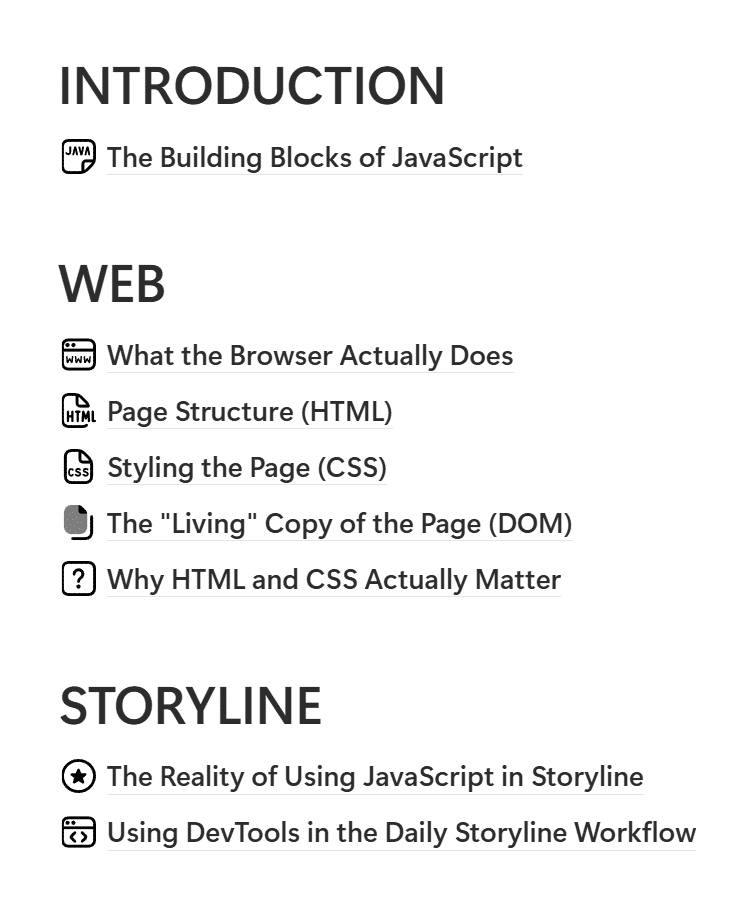
Section 2 — A Practical System for Using JavaScript in Storyline
The heart of the course. Broken down into four clear, easy-to-follow steps for creating any effect or interactive element, covered in detail. Nothing is taught in isolation — every line of code or concept is introduced only when it's needed to solve a specific task. Lessons build on one another, and by the end, this four-step structure becomes your working map: when you face a new challenge, you'll know which path to follow, from idea to implementation.
The Live LabA gift, not part of the course
This isn't part of the course you're buying, and it was never in the plan. It's a small, unplanned gift — something I add simply because I enjoy sharing with my students now and then. From time to time, a new hands-on lesson appears here, each one walking through a single interaction from start to finish. Right now there are four:
- Progress indicator
- Progress bar
- Checklist
- Flip cards
You can see all of them in action in our examples.
How each lesson is presented
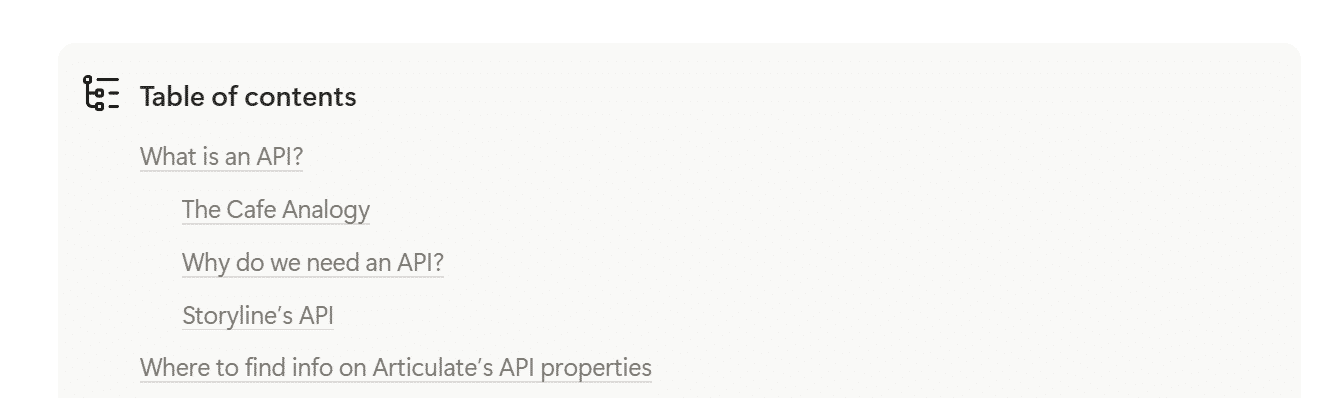
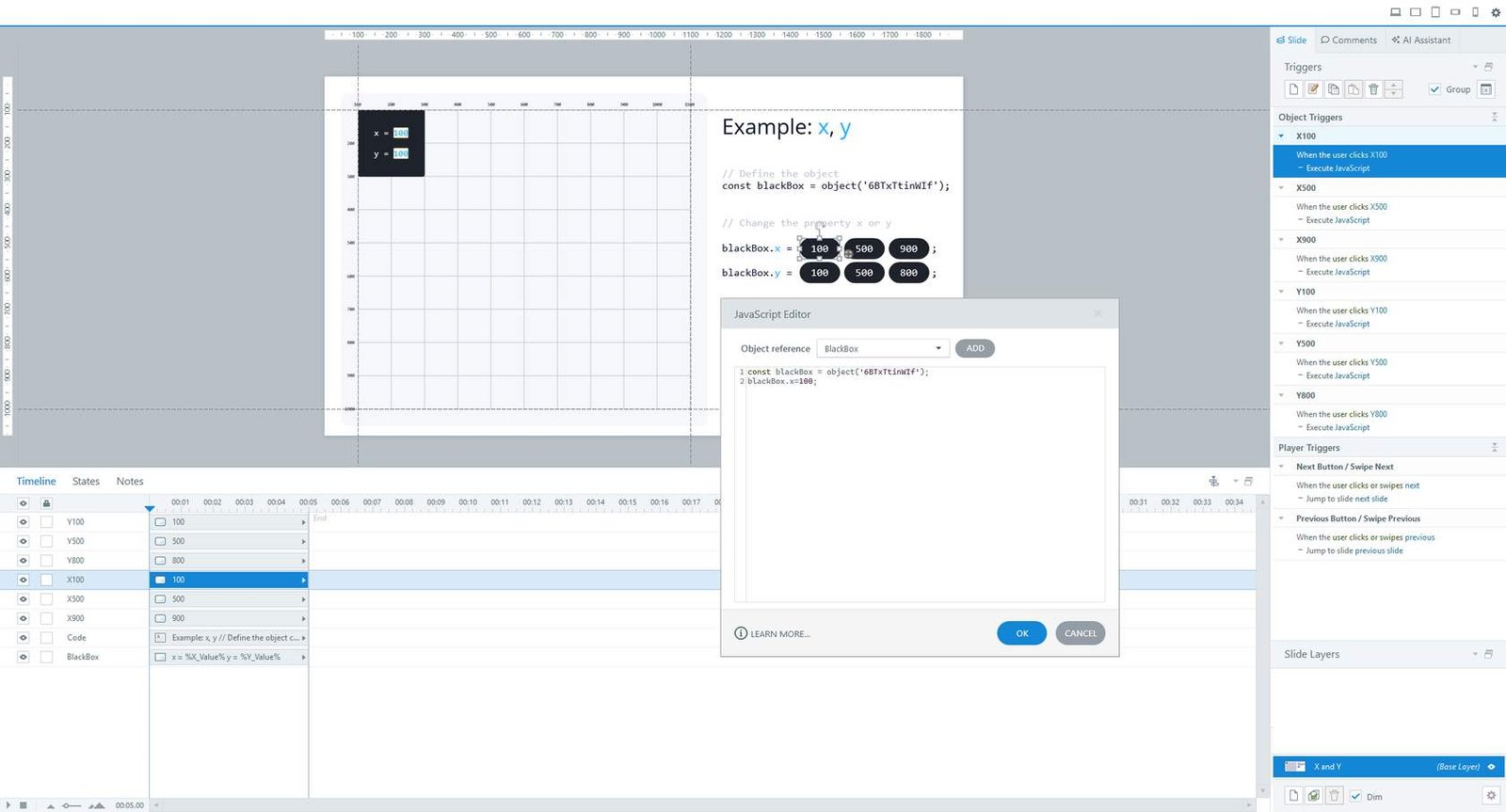
Every topic is a dedicated Notion page with clear structure and internal navigation. Each page pairs a step-by-step explanation of the mechanism with a practical Storyline example implementing it in a real interaction — theory and practice stay together on the same page. Dynamic behavior and code execution are shown through short embedded video demos, and practical examples include downloadable Storyline source files.

Course in numbers
Try the approach before you buy
Instead of relying on promises, you're welcome to evaluate the teaching style and results in practice first.

A webinar sharing a condensed version of this course system. Spend one hour creating a first visual effect and interactive element — no coding knowledge required. It's the best way to see if the pace and logic resonate with you.
Watch the webinar →
A series of articles from where this journey began. Though Articulate radically updated its JavaScript integration in March 2025 — making some parts legacy content — it remains a strong entry point: basics explained simply, in the same text–example–logic delivery style used throughout the course.
Read the articles →
The course newsletter archive includes a practical lesson on building a carousel — not just theory, a functional tool. Build it in 15 minutes and decide if you're ready to level up.
Complete the lesson →Enrollment details
How to get access
Once you pay via PayPal, I'll receive a notification with your email address. Within 24 hours, I manually add that email to the guest list for the course page in Notion.
You'll receive an automated email from Notion, and the course will appear in your sidebar under Shared.
If you don't see the email after 24 hours, check your spam folder or reach out to me directly at natavostretsova@gmail.com.
Requirements
To comfortably follow the program and complete the practical assignments, please make sure you have the following:
Please make sure Notion is accessible in your country before purchasing access to the course.
Format & duration
The entire course is hosted on Notion. Learn however you like — via browser, desktop app, or on your phone/tablet.
Access to the materials is guaranteed for at least one year.
Currently the course is a finished product, with no immediate plans for updates. If any additions are made in the future, you'll find that information right on the main course page.
About support
This is a self-study course. Please note that the format does not include:
Refunds & ethics
Since you gain full access to the intellectual property immediately after payment, no refunds will be issued. Please make your decision to purchase thoughtfully.
Regarding access — I can't control how you manage your personal email account, but I rely on your professional ethics and respect for my work by default.
Company-sponsored learning
If your employer is covering the cost of this course, you may need to provide additional information during your company's internal approval process.
To make this easier, I've prepared a Course Overview (PDF) that summarizes the course objectives, learning outcomes, structure, format, and target audience. You're welcome to download it and share it with your HR or Learning & Development team.
JS for IDs (Course Overview).pdf ↓Certificate of completion
By default, this course does not include a certificate.
However, I understand that some companies require formal confirmation of completed training. If your employer needs one, I'll be happy to issue a Certificate of Completion upon request.
About the author
I'm Natalia, founder of BusyCapybara — a manager, developer, and designer who's truly passionate about what she does. I wrote this course myself.
For me, design in learning isn't just decoration — it's a visual language that manages attention and makes complex concepts clear, and I'm convinced high-quality visuals are the foundation that determines whether a course achieves its goal. This course was born from my drive to push past Storyline's limitations: after a long process of finding ways to break out of its standard functionality and testing them in real projects, that experience is now systemized here.

Ready to level up your Storyline builds?
€300 · self-paced · hosted on Notion · access for at least one year.
Get the course{{ legal.title }}
{{ legal.intro }}
{{ sec.h }}
{{ para }}
Tell us what you'd like to create, update, or improve.
Even if your project is still just an idea, we'll help you work out where to start and provide a clear cost estimate.
Prefer not to fill out a form?
If you'd rather reach us directly, write to us at letstalk@busycapybara.com.